


What the Heart Inherits: Love, Family, and the Weight of Inherited Histories of Genevieve Asenjo’s The Melancholy of the Tongue
Words by Chelsea Castillo, In The Mix Magazine
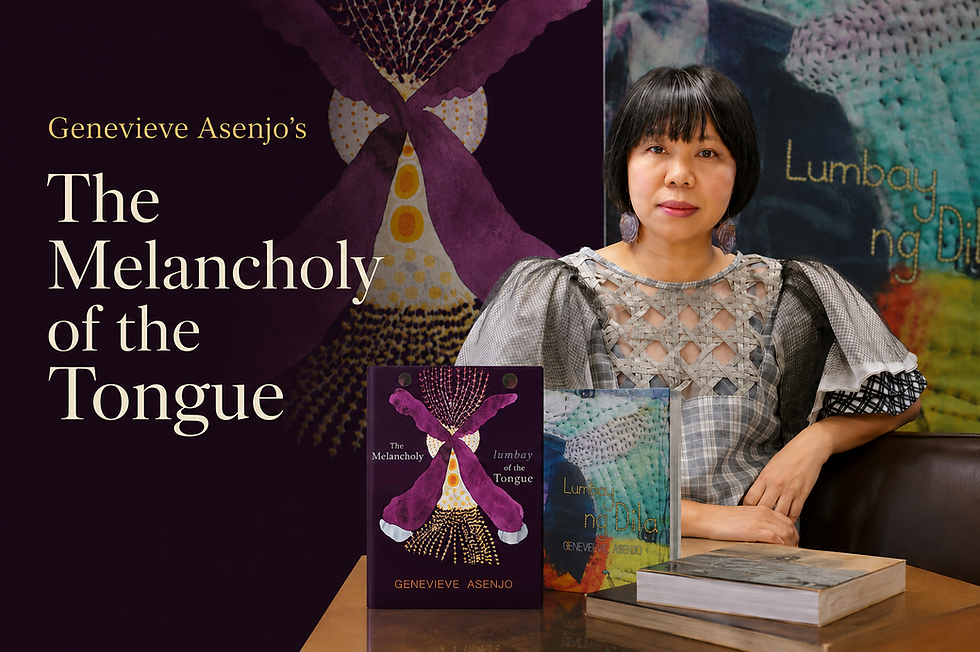
Lumbay ng Dila, written by Genevieve Asenjo and translated into English by Ana Margarita Nuñez, is a multi-genre novel that follows the life of Sadyah Zapanta Lopez, a young woman who grows up unaware of her true parentage and the complex history tied to her family's past. As Sadyah uncovers the truth about her lineage, she is forced to confront a series of scandals surrounding her family. Her grandfather was imprisoned for 21 years after being convicted as the mastermind behind the murder of his political rival, Governor Edgardo Salazar, while her parents were associated with the New People's Army (NPA), a revolutionary movement that sought to liberate Filipinos from systemic oppression and capitalism.
Beyond Sadyah's search for her identity and family history, the novel also explores her emotional and romantic relationships. Through her encounters with three different men, Sadyah gradually develops a deeper understanding of herself, love, and the complexities of adulthood. Each relationship shapes her perspective in distinct ways, contributing to her personal growth and the woman she ultimately becomes.
The Enduring Themes of The Melancholy of the Tongue: From Intimate Innocence to Matured Understanding
Sadyah's romantic life is the novel's emotional compass, tracing her journey from youthful idealism to a more measured understanding of love. Rather than presenting romance as a straightforward search for "the one," Melancholy of the Tongue frames each relationship as a lesson that reshapes how Sadyah understands intimacy, trust, and companionship. Stephen Chua, Ishmael Onos, and Priya Iyer are not merely love interests passing through the narrative; together, they chart the gradual maturation of a woman learning to distinguish longing from genuine connection.
Stephen Chua embodies the innocence of first love. Their relationship begins in the era of Yahoo Messenger, where conversations, flirtatious text messages, and tentative dates create a romance sustained as much by anticipation as by reality. Asenjo captures the exhilaration of these early encounters with remarkable warmth, from Stephen bringing food through Manila's floodwaters to their hesitant first kiss, moments that convince Sadyah she has found the security she longs for. Yet that illusion quickly gives way to disillusionment. Stephen's response to their pregnancy scare exposes the unequal emotional stakes between them, revealing a man more concerned with protecting himself than standing beside the woman he claims to love. For Sadyah, it is her first painful realization that affection without responsibility cannot sustain a relationship.
If Stephen teaches her what love should not be, Ishmael Onos offers the promise of something deeper. Bound by shared experiences of historical violence and cultural displacement, Sadyah finds in the Tausug Muslim a relationship rooted in empathy rather than infatuation. Their shared understanding allows her to confront emotional wounds she has long carried, suggesting that healing is possible through genuine companionship. However, Asenjo refuses to romanticize shared trauma. Ishmael's eventual betrayal underscores one of the novel's most sobering truths: similar histories may foster understanding, but they do not guarantee lasting commitment.
Only with Priya Iyer does Sadyah arrive at a love defined by emotional maturity rather than emotional need. Their quiet "balcony romance" unfolds through ordinary moments—late-night conversations, shared meals, music, and comfortable silences—that gradually build a relationship founded on mutual respect. Unlike the men before him, Priya neither idealizes nor retreats from Sadyah's complexity. More importantly, Sadyah herself has changed. She no longer seeks validation through love but enters it with a clearer sense of self, embracing Priya's imperfections while imagining a future in which he becomes part of the life she has already learned to claim as her own. By the novel's end, love is no longer an escape from loneliness but an extension of the maturity she has earned through experience.

Unearthing the Ghosts of Panay: From Closed-Up Thinking to Open Maturity
While Sadyah's romantic relationships reflect her emotional growth, her search for identity forms the novel's emotional core. Raised by Auntie Fely in Barasanan, she grows up surrounded by stories of Panay's myths and ancestors but knows little about her own family's past. The silence surrounding the Lopez family—its violence, politics, and tragedies—leaves her with only fragments of her identity, leading her to embrace the certainty of academic life over the uncertainty of political history.
Everything changes when her grandfather, Marcelo Nones Lopez, is acquitted of the Guinsangan Bridge Massacre. Determined to uncover the truth, Sadyah studies the court's 129-page decision herself, using it as the starting point for understanding her family's history. Through this investigation, she discovers that her father, Leandro, was an ilahas who died during the Guinsangan incident, while her estranged mother, Teresa, is the revolutionary known as Kumander Rafflesia. These revelations replace inherited silence with a more complex story of love, revolution, sacrifice, and loss.
Rather than presenting truth as liberating, Asenjo shows that understanding one's past comes with pain and uncertainty. By choosing to meet her mother and accept her family's complicated history, Sadyah learns that identity is not built on comforting narratives but on confronting difficult truths. In Melancholy of the Tongue, maturity lies not in escaping one's inheritance but in finding the courage to embrace it.
Genevieve Asenjo's The Melancholy of the Tongue (Lumbay ng Dila) is more than a coming-ofage story or a family drama; it is a meditation on how love, memory, and history shape one's sense of self. Through Sadyah's romantic relationships and her gradual confrontation with her family's hidden past, the novel suggests that maturity is not achieved by leaving the past behind but by learning to live with its complexities. Love teaches her vulnerability, while history teaches her accountability, and together they reveal that identity is neither inherited whole nor discovered all at once—it is patiently assembled through difficult choices, painful truths, and the courage to keep asking questions.
Ultimately, The Melancholy of the Tongue leaves readers with the understanding that what we inherit is more than a family name or a history of triumphs and failures. We also inherit stories waiting to be told, silences waiting to be broken, and the responsibility to decide what those legacies will mean for our own lives. In giving voice to both personal longing and collective memory, Asenjo crafts a novel that is as emotionally intimate as it is politically resonant, making it a deeply rewarding read for anyone interested in the intersections of love, identity, and history.


Comments