


Filipino Pastry in Europe: How Bakeries Are Building Demand City by City
Words by Mye Mulingtapang

Across Europe, Filipino pastry isn’t arriving quietly. It’s being plated, branded, and argued for—city by city, counter by counter—by people who understand that dessert is never just dessert.
Walk into Forn de Manila and the model tightens around volume. Bread leads. Pandesal anchors daily consumption—not as a cultural symbol, but as a repeat product. The menu builds around it: kalihim, pan de coco, ensaymada, egg pie. Familiar enough to convert, distinct enough to differentiate.
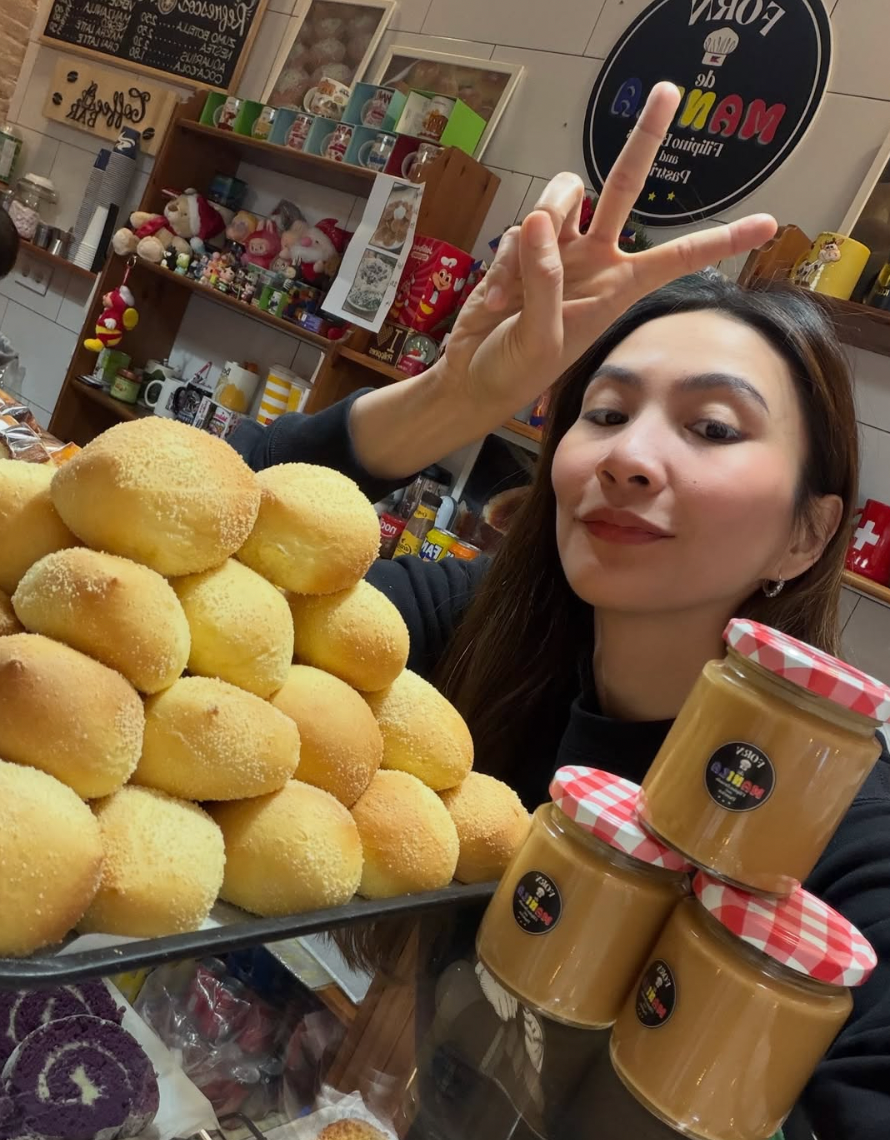
Pricing stays accessible to drive frequency. This isn’t about one-time discovery. It’s about habit formation. The so-called “Spanish bread” isn’t a coincidence—it’s a deliberate naming bridge, lowering friction while maintaining product integrity.
In Haarlem, Chibog Oriental Fusion Cuisine strips the model down further. Smaller city. Lower margin for error. The strategy is retention. No aggressive expansion, no overextended menu. Pricing encourages return. The product mix leans on reliability over novelty. Growth here is slow by design. Loyalty compounds. That’s the engine.
Translation—not dilution—is the constraint. And it’s harder than most get right.

In Milan, Baker’s Place Tinapayan operates inside one of Europe’s most rigid food cultures. Bread here is codified. Pastry is disciplined. Competing directly is a losing strategy. So Tinapayan sidesteps the frame. Ensaymada isn’t introduced as a brioche variant. It’s presented as its own category—soft, rich, finished with sugar and cheese that disrupts expectation. That disruption is intentional. First purchase confuses. Second clarifies. Third converts. Pricing holds steady—neither novelty-cheap nor premium-inflated—forcing the product to justify itself through repetition.
This is where the “comfort food” narrative collapses. Comfort doesn’t scale. Systems do.

Look at Kasa and Kin. London doesn’t reward hesitation. It rewards clarity and confidence. Here, Filipino desserts sit inside a broader dining framework—integrated, not isolated. Ube appears in plated formats, cocktails, desserts that carry full pricing weight in a competitive Soho market. Nothing is discounted for unfamiliarity. The strategy is alignment: meet London at its level, not below it. Product, service, and pricing move together. That’s how you avoid being categorized as niche.

Shift to Taza Artisan Cafe and the hierarchy is clear. Ube is not a feature. It’s the core product. The cakes are saturated in color, structured to hold, and priced alongside premium café offerings—not below them. No soft entry. No “try this if you’re curious.” The assumption is that the product belongs. That’s the positioning. The real work happens underneath—adjusting sweetness, tightening texture, controlling portions—so the product lands without losing identity. This isn’t reinvention. It’s calibration.

Different cities. Same constraint: demand doesn’t exist until you build it.
Strip away the language of “cultural exchange,” and what remains is operational. These businesses are engineering entry points. Every decision—price point, portion size, product naming, display—answers the same question: will this convert, and will it repeat?
Too expensive, and curiosity dies early. Too cheap, and the product loses authority. Too foreign, and it alienates. Too adapted, and it erases itself. There is no stable middle. Only constant adjustment.
Some operators hold the line on authenticity and risk slower growth. Others adapt aggressively and risk flattening what made the product distinct. Both paths are unstable. Both require correction. There is no clean playbook—only feedback loops.
What holds across all five is discipline. Not branding. Not narrative. Discipline in product.
Discipline in pricing. Discipline in knowing when to push and when to edit.
And not all of them will last. Some will misread their market. Some will scale before demand stabilises. Others will stay too cautious and stall out. That’s not failure. That’s exposure—operating in markets that were never designed for your product.
But the ones that hold—on pricing, on positioning, on product integrity—do more than survive.
They reset expectations. Filipino pastry stops being an introduction. It becomes an option. Not a trend. Not a feature. A category.


Comments